Inside Capital One: Hidden Tech Buying Signals Every Strategic Account Team Needs To Know

Capital One Financial Corporation
1680 Capital One Drive
McLean, VA 22102
United States
Main Phone: (703) 720-1000
Website: https://www.capitalone.com
Industry Sector: Financial Services, Credit Services
Full Time Employees: 76,300
Fiscal Year End: December 31
Annual Revenues: $32.78 Billion USD
CEO: Richard Fairbank
Fortune 500 Rank: #150
Capital One has stacked several major strategic moves in the last 30–90 days that are rich sales triggers for an enterprise tech seller, especially around AI-native software, data, and operational transformation. In this post, we break down what those moves actually mean for you as a seller: where new budget and urgency are emerging inside Capital One, which teams are likely feeling the most pressure, and how to translate their public strategy into sharp, relevant outreach. You’ll see concrete guidance on who to call on, what to say in your first touch, and how to position your solution so it sounds like it was designed for Capital One’s current priorities—not a generic big-bank pitch.
Where are the biggest technology sales opportunities inside Capital One right now?
Several strategic programs at Capital One create heavy, sustained demand for modern software, data, and infrastructure solutions.
- Discover network and card integration: The Discover acquisition gave Capital One full ownership of a global card network and associated technology stack, and executives have been explicit that modernizing Discover’s data centers and mainframes onto Capital One’s cloud-native stack will take “a whole bunch of years.”
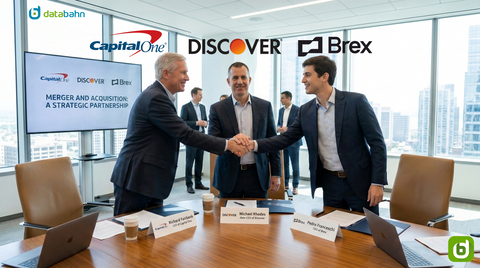
- Brex acquisition and B2B software: The $5.15B acquisition of Brex adds an AI-native corporate card and spend management SaaS layer, specifically targeting startups and enterprises with modern workflows.
- AI and cloud infrastructure evolution: Capital One is already 100% in the public cloud and is now dealing with the hidden costs of advanced AI, reportedly exploring alternatives or complements to AWS for GPU-heavy workloads because AI spend is “getting out of hand.”
- Capital One Software and data products: The internal software division has shipped Slingshot (to optimize Snowflake/Databricks) and Databolt (a vaultless tokenization platform to secure sensitive data and feed generative AI safely), proving there is both internal and external demand for sophisticated data management.
-
Digital-first banking and payments experiences: Capital One’s customer-facing properties emphasize digital tools, mobile, and simplified business finances, which implies continuous investment in experience optimization, security, and reliability across web and app surfaces.
For a technology seller, these translate into opportunity in at least five domains: integration and modernization tooling, AI infrastructure and governance, data security and observability, developer productivity and platform engineering, and customer/employee experience technologies that sit on top of these platforms.
How should a technology rep frame Capital One as a target account in their internal strategy?
Internally, you should position Capital One as a “tier-1, transformation-in-motion” account where timing and context are as important as product fit.
- Acknowledge their maturity: Capital One is not catching up; it is leading on cloud and AI and has already closed its data centers in favor of a cloud-native stack. You are not selling basic modernization—you are selling leverage, control, and efficiency on top of an advanced platform.
- Treat M&A as a forcing function: The Discover and Brex deals create multi-year integration programs with large budgets but also real execution risk, which is where best-of-breed platforms can justify premium pricing.
- See Capital One Software as both partner and competitor: Slingshot and Databolt solve specific data pain points, but they also validate the importance of observability, security, and cost visibility around cloud data platforms; you can either complement or extend those investments.
In account planning, assume sophisticated buyers, long but well-structured procurement cycles, and the need to align with enterprise architecture, security, and risk stakeholders early.
Capital One Org Chart - Executive Leadership Team


Who should you call on first at Capital One?
Your initial targets should map to the programs under the most pressure: Discover network integration, Brex integration, AI cost management, and secure data sharing.
Likely priority personas include:
Technology strategy and enterprise architecture
- Senior leaders overseeing Discover integration, responsible for moving Discover card systems onto Capital One’s tech stack and modernizing the global network.
- Enterprise architects accountable for cloud-native patterns, microservices, and AI infrastructure across AWS and any emerging hybrid environments.
Data, AI, and platform engineering
- Heads of data platforms and AI who rely on Slingshot and Databolt to manage Snowflake/Databricks environments, secure sensitive data, and feed AI models.
- Directors of MLOps, data engineering, or AI platforms responsible for GPU utilization, AI model deployment, and cost management in the cloud.
Security, risk, and compliance
- CISOs and data security leaders concerned with tokenization, third-party data sharing, and safe generative AI ingestion.
- Risk and compliance executives who must ensure that Discover and Brex integrations meet regulatory and internal control standards.
Line-of-business and product owners
- Heads of payments, commercial cards, and business banking whose P&L depends on integrating Brex’s AI-native workflows and Discover’s network capabilities into Capital One’s digital experiences.
- Digital product and UX leaders for capitalone.com, mobile apps, and business banking portals focused on reliability, experimentation, and personalization.
As a pattern, start with technical and platform owners for credibility, then expand to P&L and product leaders who benefit from the outcomes your platform enables.
What should you say in your initial outreach—and why will it resonate?
Your messaging should explicitly reference Capital One’s visible strategic moves and language from its own properties, then map those to a concrete business problem that your solution addresses.
Brex integration and B2B finance modernization

Why it matters: Capital One is buying Brex’s AI-native software platform to own more of the B2B spend-management and corporate card stack, layering software and AI on top of its bank infrastructure. This means complex integration, workflow, and data challenges.
What to say:
- Open with: “As you bring Brex’s AI-native spend management onto Capital One’s cloud stack and unify it with your business banking experience, how are you approaching X?” where “X” is your wedge—observability, workflow automation, test environments, API security, etc.
-
Tie to their language: Refer to “simplifying business finances” and “digital tools built for ease,” echoing how they talk to their business customers.
- Close with a low-friction call to action: Offer a 30-minute working session focused on one integration or migration risk they are already grappling with.
Discover network and multi-year modernization
Why it matters: Executives have said that integrating Discover’s card business and network into Capital One’s modern tech stack will take years, and that they will “go back into the world of data centers” while modernizing the global network and eventually moving it fully to the cloud.
What to say:
- Lead with: “You’ve built a cloud-native stack ideally suited for acquisitions, but Discover’s data centers and mainframes mean a long, complex integration journey. Customers in similar situations use our platform to reduce integration risk and accelerate network modernization.”
- Quantify the stakes: Reference their stated cost and network synergy targets (without restating numbers exactly) to show you understand that time-to-synergy and reliability are executive-level concerns.
AI cost management and infrastructure evolution
Why it matters: Capital One’s AI workloads are significant enough that internal discussions have reportedly considered alternatives to AWS for certain AI tasks, due to escalating costs.
What to say:
-
Start with: “As your AI workloads scale, many institutions like you are seeing cloud bills get out of hand; we help teams get granular visibility and control over AI infrastructure costs without slowing innovation.”
- Align with their posture: Acknowledge that they are already elite in AI and cloud (“you were early to 100% public cloud and are now ahead on agentic AI”), and position your solution as a precision instrument, not a basic cost-cutting tool.
Secure data sharing and gen AI enablement (Databolt-adjacent)
Why it matters: Databolt shows Capital One’s commitment to tokenization and vaultless data security that preserves format and referential integrity, enabling secure third-party data sharing and safe generative AI.
What to say:
Acknowledge: “Databolt and Slingshot are impressive; they show how seriously you treat secure, high-performance data access for AI and analytics.”
Position around:
- Complementary capabilities (e.g., monitoring tokenized data flows, testing and validation, data quality, lineage)
- Adjacent environments (e.g., other cloud platforms, specific application domains, or third-party SaaS data that sits outside Databolt’s current scope)
In all outreach, keep the tone peer-level, grounded in their public strategy, and focused on specific jobs-to-be-done rather than generic benefits.
How should you approach Capital One’s buying process?

Given Capital One’s sophistication and regulatory environment, you should assume a multi-stakeholder, methodical process that still values speed and innovation.
-
Lead with discovery, not demos: Use your first conversations to map their specific program (e.g., a Discover migration phase, a Brex rollout milestone, an AI platform initiative) and the key technical constraints.
- Multi-thread early: Connect security, architecture, and business owners by framing your solution as reducing risk and accelerating value realization from marquee acquisitions and AI investments.
- Bring tangible proof: Capital One is itself a software and data company; they will expect performance benchmarks, reference architectures for cloud-native environments, and case studies with other highly regulated, large-scale customers.
- Align to executive narratives: Reference themes like “modern payments infrastructure,” “leading AI maturity,” “cloud-native operations,” and “simplifying business finances” that show up in external analysis and on capitalone.com.
A practical way to orchestrate this: run a short discovery sequence with architecture or platform engineering, validate security and compliance constraints with InfoSec, then co-create a pilot with a line-of-business owner where success metrics tie directly to an integration or AI initiative already on the roadmap.
What concrete talk tracks can a technology rep use in calls and emails?
Below are example talk tracks you can adapt, depending on your category.
For data / platform / observability tools
“You’ve already built a cloud-native, microservices-based stack and launched products like Slingshot and Databolt, which tells me you care deeply about cost visibility, governance, and secure data access at scale. Teams in similar environments use us to see exactly how network integrations, AI workloads, and new B2B products impact performance and spend—before it shows up in financials or customer experience metrics.”
For security / privacy / compliance solutions
“Your Databolt launch and tokenization approach are best-in-class, especially as you expand data sharing and generative AI. The gap we typically see is in continuously validating security and compliance across hybrid estates during multi-year migrations—like the Discover network modernization you’ve described—and making that evidence consumable for risk and audit teams.”
For AI / ML / infrastructure optimization platforms
“Capital One is already recognized as an AI leader, but the hidden costs of advanced AI—especially GPUs and large models—can grow faster than business value. You’re exploring infrastructure options beyond AWS; we help AI platform teams get control over where workloads run, how resources are allocated, and how to tie that back to use-case-level ROI, without slowing down model delivery.”
For experience optimization / experimentation tools
“Capital One’s promise of ‘digital tools built for ease’ across cards, banking, and business solutions sets a high bar for your web and mobile experiences. As you bring Discover and Brex capabilities into those journeys, our platform helps product teams experiment safely, personalize at scale, and monitor the impact on both customer outcomes and risk controls.”
Each talk track is explicitly anchored in something Capital One has already done or said, which increases credibility and makes it easier for prospects to see the relevance to their current priorities.
How can you sustain momentum and grow within the account?
Finally, treat initial wins as footholds into a broader, multi-year partnership.
- Land against one visible program: e.g., a Discover integration milestone, a Brex rollout phase, or a specific AI workload cluster where costs or risks are already acute.
- Expand by aligning to Capital One Software and data leadership: Show how your platform coexists with Slingshot and Databolt and helps Capital One’s internal software division deliver even more value to external clients and internal stakeholders.
- Regularly mirror their evolving narrative: As capitalone.com, investor commentary, and tech blogs update around AI, payments, and global network ambitions, keep your account messaging aligned so you always sound like you’re selling into the current Capital One, not the one from two years ago.
If you tailor these principles to your specific SaaS category—security, data, RevOps, experimentation, or something else—you can show up at Capital One as a peer to their technologists and a lever for their executives, rather than just another vendor knocking on a very busy door.
Reach out if you're looking for a deeper dive into Capital One (detailed org charts, contact info, tailored sales strategies and messaging, cold prospecting email templates, CapOne tech stack, IT budget forecast for 2026, competitor battlecards, etc.)