The Enterprise SaaS Playbook for the Fox-Roku Merger's Messiest, Most Profitable Overlaps
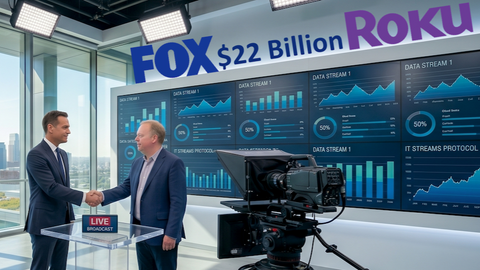
On June 15, 2026, Fox Corporation announced a definitive agreement to acquire Roku, Inc. in a cash-and-stock deal valued at roughly $22 billion in enterprise value. Fox will pay $160 per share, split between $96 in cash and 0.9693 shares of Fox Class A common stock, a 34% premium to Roku's pre-announcement price. The deal is expected to close in the first half of 2027, with Fox shareholders ending up owning about 73% of the combined entity.
The strategic logic is straightforward: this pairs Fox's premium live sports, news, Tubi, and the FOX One direct-to-consumer platform with Roku's connected TV operating system, which reaches more than 100 million streaming households globally. The combined company becomes the third-largest U.S. television platform by share of viewing. Fox CEO Lachlan Murdoch called it a defining moment for the company.
For enterprise SaaS AEs, this opens a time-sensitive greenfield window at two Fortune-level accounts at once. Fox and Roku stay legally separate, with independent procurement authority, until close, which means two distinct buying centers, two budget cycles, and two sets of decision-makers to engage right now (there's a fuller deal snapshot graphic if you want the visual version of the numbers above).

Tech stack intelligence: Fox vs. Roku
Technographic analysis shows Roku running a significantly larger and more complex stack than Fox, 128 catalogued tools versus Fox's 92. Fifty-seven vendors appear in both organizations simultaneously, and those shared vendors are the immediate rationalization targets the moment the deal closes; they're also the highest-urgency conversations happening right now (a side-by-side stack comparison graphic covers both in full).

Where the stacks align: the 57 shared vendors
The overlap is striking. Both companies independently run Workday for HRMS and payroll, Snowflake, Databricks, Anaplan, Tableau, Atlassian JIRA, Atlassian Confluence, Slack, Microsoft Office 365, Google Workspace, Datadog, Okta, AWS, Palo Alto Networks, SAP Concur, Braze, HubSpot, Looker, BlackLine, NetSuite, Comscore, FreeWheel, LiveRamp, VideoAmp, and SpringServe. Every one of those contracts will be renegotiated before December 2027, and whichever AE has established a champion relationship in the pre-close window controls how that consolidation conversation goes.
Both companies also lean heavily on Amazon Web Services as their primary cloud provider. Fox named AWS its preferred AI cloud partner in April 2026, and Roku has run its platform on AWS CloudFront and core compute since its earliest days. That shared commitment gives any AE selling cloud-adjacent SaaS a unified infrastructure story that works at both accounts.
Where the stacks diverge: the real gaps
Roku's AI and ML depth goes well beyond Fox's. Roku runs a full model development and deployment pipeline, Hugging Face, NVIDIA CUDA, PyTorch, TensorFlow, MLflow, Kubeflow, and Amazon SageMaker. Fox operates mostly at the application layer with SageMaker, Claude, ChatGPT, Google Gemini, and Salesforce Agentforce. Post-merger, Fox inherits Roku's AI infrastructure, which is an immediate integration problem and a high-value conversation for anyone selling MLOps, AI governance, or enterprise AI platforms.
Roku's HR and talent stack is roughly three times deeper than Fox's. Roku runs Greenhouse, iCIMS, Lever, Workday Recruiting, Workday HCM, Docebo, LinkedIn Learning, Culture Amp, GoodTime, Gem, HackerRank, and SAP Workforce Management. Fox runs Workday, ADP, and LinkedIn Recruiter. As Fox absorbs Roku's roughly 3,800-person workforce, the question becomes urgent: rationalize down to Fox's simpler stack, or adopt Roku's full HCM platform company-wide. That's a live whitespace conversation for anyone selling workforce management, learning and development, or talent acquisition SaaS.
The collaboration platform conflict is unresolved. Fox's core is Google Workspace plus Slack. Roku runs Microsoft Teams, Microsoft Exchange, Microsoft Outlook, Slack, and Google Workspace all at once. The combined org will eventually have to choose between Teams and Slack, and between Google Workspace and Microsoft 365. Any AE in collaboration or enterprise communication has a direct, time-sensitive opening here.
Roku's ad-tech ecosystem is far broader and more open than Fox's. On top of the shared FreeWheel, LiveRamp, VideoAmp, and SpringServe, Roku independently runs The Trade Desk, Xandr, PubMatic, Rubicon Project, Integral Ad Science, Nielsen Ad Intel, AdImpact, Publica, and SpotXchange. Fox's ad-tech is more consolidated around Google (Ad Manager, DoubleClick, Interactive Media Ads) plus its own FreeWheel and SpringServe deployments. Every one of Roku's 14 unique ad-tech vendors is now at risk of rationalization as Fox applies its more centralized ad operations model to the combined entity.
Oracle concentration risk shows up at both companies. Fox uses Oracle BlueKai in its advertising DMP stack and Oracle NetSuite for ERP. Roku uses Oracle ERP Cloud and NetSuite independently. That double-Oracle exposure across ERP and advertising data management is a compelling displacement conversation for anyone selling a competitive alternative in either category.
Salesforce depth is uneven. Fox runs Salesforce CRM, Marketing Cloud, Data Cloud, Service Cloud, and Agentforce. Roku runs Salesforce CRM, Sales Cloud, Service Cloud, and Inbox, with no Marketing Cloud and no Data Cloud. Post-merger, that gap is either a major Salesforce upsell or a competitive displacement opportunity for any CDP or marketing automation vendor that moves before a standardized Salesforce stack gets mandated across the combined entity.
Security infrastructure needs immediate reconciliation. Fox's posture centers on CrowdStrike and Tanium for endpoint protection, Okta for identity, and Palo Alto Networks for firewall. Roku adds Splunk for SIEM, CyberArk for privileged access, SailPoint for identity governance, Cloudflare for DDoS and WAF, plus Microsoft Defender, Sophos, and HashiCorp Vault. Fox currently has no SIEM at all. Whoever becomes the post-merger CISO faces a direct endpoint conflict, CrowdStrike versus Sophos and Microsoft Defender, and has to decide whether Splunk becomes the enterprise standard SIEM (both companies' full org charts and executive leadership rosters are worth pulling if you're mapping stakeholders here).


Sales plays: pre-close, now through H1 2027
Fox and Roku remain legally separate with independent procurement authority until close. That means an AE has two live buying centers right now.
Play 1, the tech stack consolidation opener: both companies have committed to $400 million in annualized cost synergies, which is the natural conversation opener for anyone who can position their SaaS as a consolidation tool that cuts vendor sprawl. Target Steve Tomsic, Fox's CFO, or Dan Jedda, Roku's CFO and COO, with a business case built around the integration timeline: you have 57 shared vendors and 18 months to rationalize them, we help you get there faster.
Play 2, the first-party data convergence play: Roku's Data Cloud platform, which connects 100 million households of first-party viewership data to clean room integrations with Adobe, Yahoo DSP, Omnicom, and Innovid, is about to inherit Fox's Tubi and Fox One streaming data pipelines. Target Scott Rosenberg, Roku's VP of Platform Business, and Lindsay Silver, Fox's SVP of Data and Commercial Technology, with anything that extends, integrates with, or modernizes the combined data infrastructure. The pitch: Roku Data Cloud is about to double in scope, the question is whether you architect that merger now or react to it in 2028.
Play 3, the HR tech disruption play: Fox is taking on $12 billion in new debt while integrating Roku's 3,800-person workforce with its own, and the HR technology gap between the two companies is real and urgent. Target Kevin Lord, Fox's CHRO, with a workforce management or organizational change platform framed around integration speed: two workforce cultures, two HR stacks, one 18-month runway, and the companies that win on culture retention are the ones who resolve HR tech early.
Play 4, the collaboration platform decision play: the Slack versus Microsoft Teams conflict is real and unresolved. Fox uses Slack and Google Workspace. Roku uses Teams, Exchange, Slack, and Google Workspace simultaneously. One platform survives. Anyone selling collaboration, enterprise search, or productivity tools should be qualifying this conversation with IT leadership at both companies immediately.
Sales plays: post-close, H2 2027 and beyond
Play 5, the vendor rationalization displacement play: the combined entity will likely carry 400 to 600 active SaaS contracts, and the new CTO and CISO will be tasked with cutting that by 30 to 40 percent in the first 18 months. AEs in categories where both companies currently run competing point solutions, endpoint security, ad measurement, analytics, collaboration, have a direct path to becoming the single-vendor standard.
Play 6, the unified CTV ad infrastructure play: Roku's advertising revenue hit $613 million in Q1 2026, up 27% year over year, at a 60.5% gross margin. Combined with Fox's Tubi platform and the Roku Exchange, the post-close entity will run one of the largest CTV advertising technology stacks in the U.S. Target Marianne Gambelli, Fox's President of Advertising Sales, and Scott Rosenberg at Roku, with programmatic infrastructure, identity resolution, attribution, and audience analytics solutions.
Play 7, the security unification play: the combined entity's CISO faces a clear mandate, reconcile CrowdStrike against Sophos and Microsoft Defender for endpoint, decide whether Splunk becomes the enterprise SIEM standard, and unify CyberArk and SailPoint identity governance across the combined workforce. AEs selling into any of these categories should be building champion relationships now, before those decisions get made.
90-day AE action plan
Days 1 to 30: map your solution against both technographic profiles, identify the shared vendors in your category and the unique tools on each side, and build your consolidation-value narrative around the $400 million synergy mandate. Start outbound to IT, finance, HR, and ad tech leaders at both accounts, using the deal announcement itself as the natural opener.
Days 31 to 60: run discovery calls framed around integration planning, not product pitches. At Fox, probe the AWS, Tubi, and Fox One infrastructure roadmap and where third-party SaaS fits into the consolidated stack. At Roku, ask about contract renewal dates and which of their 65 unique tools are under active review. Qualify who's making SaaS decisions before close versus after.
Days 61 to 90: submit proposals framed as integration-ready and consolidation-friendly, and build champions at both organizations so your solution survives the post-merger vendor audit regardless of which team ends up leading procurement. The urgency is already built into the deal, a known close date in H1 2027 gives your business case a natural deadline.
If you'd like a complimentary two-page sales intelligence brief on what this would look like for your company and focus areas, follow me on LinkedIn and DM me "Fox/Roku".
Sources:
https://www.reuters.com/business/media-telecom/fox-buy-roku-22-billion-deal-2026-06-15/
https://www.foxcorporation.com/management/executive-team/
https://www.roku.com/investor/management