

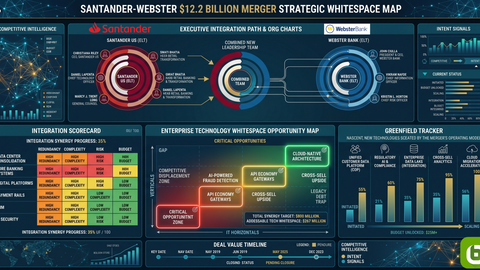
For sales leaders targeting financial services: most reps will chase the obvious plays, core banking replacement, branch consolidation tech, new CRM overlays. The real money sits in the silence between the press releases.
Santander's $12.2 billion acquisition of Webster Bank, announced in February 2026 and approved by shareholders on May 26, creates a compressed integration window likely to drive systems rationalization, governance complexity, and new buying urgency across cloud, security, data, compliance, payments, and customer experience. For enterprise sellers, this isn't a generic digital transformation story so much as a near-term operating model reset with real whitespace for vendors who can help reduce execution risk.
Here's the hidden opportunity: when two banks combine, the headline is scale, but the practical reality is duplicated platforms, inconsistent data, overlapping workflows, and new executive accountability. Those conditions tend to create greenfield demand before any full platform consolidation decision gets made.
Where the pressure starts
Santander and Webster laid out post-deal leadership and integration plans in spring 2026, including new responsibilities for Luis Massiani, John Ciulla, Ignacio Sarquis, and Vikram Nafde. That matters because leadership transitions usually trigger budget reviews, vendor rationalization, and day-one readiness projects that need solving before a long-term architecture is even finalized.
For sellers, the first lens should be organizational pressure, not product fit. A new integration leader gets measured on continuity, cost savings, and speed. A new bank CEO gets measured on growth, retention, and profitability. Those two mandates shape which solutions get urgent attention through Q3 and Q4 2026 (their post-merger org chart lays out the reporting lines if you want the full picture).

The biggest whitespace categories
Core banking and API management. Santander has been public about its broader technology transformation and its Gravity-led modernization work, and Webster brings its own digital banking and BaaS-related infrastructure history. Even without full visibility into both banks' internal architecture, a merger like this strongly implies a dual-platform environment in core operations, customer servicing, and integration middleware for the duration of the transition. That's an opening for API management, orchestration, and data synchronization vendors: if the bank has to keep both environments running while deciding what to retire, sellers can position around integration speed, reduced migration risk, and continuity of customer and transaction flows.
Cloud, data, and analytics. Bank M&A tends to expose hidden data debt: duplicate customer records, mismatched schemas, conflicting reporting logic, inconsistent governance across platforms. At this size, that makes cloud cost optimization, data lineage, MDM, and analytics modernization more urgent, because the combined institution can't hit its synergy targets if it can't trust its own data layer. This is where cloud infrastructure, data platform, and AI analytics teams can find greenfield entry, and the strongest message isn't "modernize your stack," it's helping the integration office build one trusted operating picture without waiting on a multiyear migration.
Cybersecurity, fraud, and compliance. Merged banks expand the attack surface. Identity systems, fraud tools, AML workflows, access controls, and audit processes often stay fragmented through the early phases of integration, right as regulatory scrutiny rises and examiners expect strong governance and evidence that operational risk is under control. That combination opens space for cybersecurity posture management, IAM, SIEM consolidation, fraud analytics, AML modernization, and GRC automation vendors, and these plays work best framed as risk reduction and regulatory readiness rather than feature pitches.
CRM, payments, and customer experience.
Santander's consumer scale and Webster's commercial and HSA strengths mean different customer journeys, product models, and service motions are coming together under one operating bank, which usually creates friction in CRM processes, call center tooling, payments orchestration, onboarding, and digital experience design. Sellers here should watch for friction signals: changed leadership ownership, customer communication campaigns, service migration notices, branch or digital process changes (Webster's own org chart is worth a look for exactly this). Those are often the earliest sign the bank needs a faster front-end unification layer before it can even get to deeper back-end consolidation.

How sellers should attack the account
The most effective motion here isn't a broad "we help banks transform" pitch. It's anchoring to a specific integration problem, tying it to a named executive's mandate, and showing how your platform helps protect the deal thesis. Roughly: Massiani-aligned plays center on operations, continuity, integration execution, and synergy capture. Ciulla-aligned plays center on growth, customer retention, commercial expansion, and revenue realization. Sarquis and Nafde-aligned plays center on architecture, infrastructure, modernization, and platform rationalization. That gives enterprise sellers a real path into multiple buying centers without waiting on a formal RFP, and turns the merger into a live whitespace map instead of just a news event.
Most sellers will chase the obvious consolidation story. The sharper ones will chase the invisible debt the merger just created, that's usually where the first urgent budgets, the fastest executive conversations, and the most credible greenfield plays show up in bank M&A.
If this merger looks like a whitespace or greenfield opportunity for you, I've got a more detailed Greenfield Tracker doc focused on the two executives whose mandates are most likely to shape near-term buying behavior inside the combined Santander-Webster operating environment: Luis Massiani and John Ciulla. I also have an Integration Scorecard doc that maps the most likely tech and data debt gaps the merger creates and translates them into immediate vendor-replacement or greenfield signals for enterprise sellers.
Connect with me on LinkedIn and DM me "Santander-Webster" and I'll send them both over. Or just drop a comment below.
Sources:
https://www.databahn.com/products/santander-org-chart-and-sales-intelligence-report
https://www.databahn.com/products/webster-financial-org-chart-and-sales-intelligence-report
https://www.databahn.com/pages/get-free-snapshot