

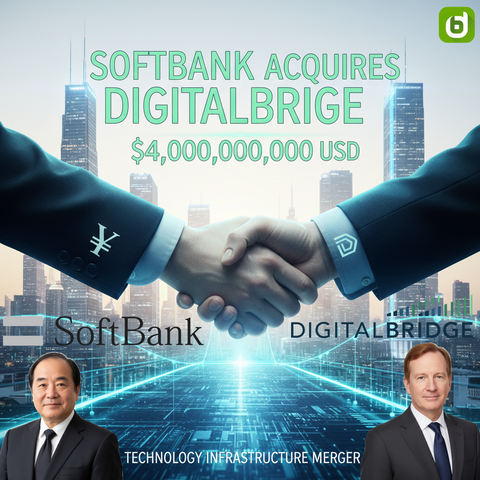
SoftBank Acquires DigitalBridge for $4 Billion
 |
 |
|
SoftBank Group Corp. OTC: SFTBY 1-7-1, Kaigan, Minato-ku Tokyo, 105-7537 Japan Main Phone: 81 3 6889 2000 Website: https://group.softbank Industry Sector: Communications, Telecom Services Full Time Employees: 67,229 CEO: Masayoshi Son, Founder, Chairman, President & CEO |
DigitalBridge Group, Inc. NYSE: DBRG 750 Park of Commerce Drive, Suite 210 Boca Raton, FL 33487 United States Main Phone: (561) 570-4644 Website: https://www.digitalbridge.com Industry: Financial Services, Asset Management Full Time Employees: 310 CEO: Marc Ganzi, CEO & Director |
SoftBank’s agreement to acquire DigitalBridge for about $4 billion is a classic “picks and shovels” bet on the infrastructure behind the AI boom, combining SoftBank’s capital and AI thesis with DigitalBridge’s global data‑center and digital‑infrastructure platform. The deal is structured as an all‑cash take‑private transaction at $16 per share, with DigitalBridge expected to continue operating as a separately managed platform under its current CEO, Marc Ganzi, once the transaction closes in the second half of 2026, subject to regulatory approvals.
Who are the CEOs of SoftBank and DigitalBridge?

SoftBank Group Corp. is a Tokyo‑based investment holding company led by founder and CEO Masayoshi Son, known for making large, high‑conviction bets in telecoms, internet, and now AI infrastructure through vehicles like the Vision Fund and Project Stargate. DigitalBridge Group, Inc. is a Boca Raton–based alternative asset manager focused exclusively on digital infrastructure—data centers, fiber, towers, small cells, and edge assets—with roughly $100‑plus billion in assets under management.

DigitalBridge is led by CEO Marc Ganzi, a long‑time digital‑infrastructure investor who previously built and sold several tower and infrastructure platforms before repositioning the former Colony Capital into today’s DigitalBridge.
SoftBank Group Org Chart - Executive Leadership

SoftBank Org Structure

Deal terms, structure, and timing
Under the definitive agreement, SoftBank will indirectly acquire all outstanding DigitalBridge common stock for $16.00 per share in cash, valuing the company at approximately $4.0 billion on an enterprise‑value basis, including debt. The $16 offer represents about a 15% premium to DigitalBridge’s closing share price on December 26, 2025, and roughly a 50% premium versus its unaffected 52‑week average closing price as of December 4, 2025.
The transaction will be executed via a merger with SoftBank affiliates (including a HoldCo/Sub structure described in DigitalBridge’s merger filings), after which DigitalBridge will become a privately held subsidiary of SoftBank Group. Closing is expected in the second half of 2026, subject to DigitalBridge shareholder approval, antitrust and other regulatory clearances, and customary closing conditions.
Headquarters and footprint
- SoftBank Group’s corporate headquarters are in Tokyo, Japan, with global investment operations spanning the Americas, Europe, and Asia.
- DigitalBridge is headquartered in Boca Raton, Florida, with investment and operating teams across North America, Europe, the Middle East, and Asia to manage its portfolio of data‑center, tower, and fiber platforms.
This cross‑border profile is part of the strategic appeal: SoftBank gains a U.S.‑based, globally deployed infrastructure manager, while DigitalBridge gets a deep‑pocketed Japanese parent aligned to the same AI‑infrastructure thesis.
What the combined company will look like
SoftBank and DigitalBridge are positioning the transaction as a strategic combination rather than a traditional operational merger, with a clear “platform within a platform” design. After closing, DigitalBridge will continue to operate as a separately managed platform under Marc Ganzi’s leadership, keeping its brand, team, and investment processes intact while tapping SoftBank’s capital and ecosystem.
In practice, a post‑deal setup is likely to include:
A standalone DigitalBridge investment platform
- DigitalBridge continues to manage existing funds and co‑investments in data centers, towers, and fiber under its own governance and incentive structures, now as a private company under SoftBank ownership.
- LP and co‑investment relationships remain central, with SoftBank joining as an anchor/strategic capital partner rather than replacing third‑party capital.
Integration at the strategy and capital‑allocation level
- SoftBank integrates DigitalBridge capabilities into broader AI initiatives, such as its roughly $500 billion Project Stargate vision for next‑generation, AI‑optimized data centers and connectivity.
- Joint pipeline development around hyperscale data centers, edge‑compute campuses, and AI‑specific infrastructure in regions where SoftBank has operator relationships but limited physical assets.
Financial consolidation, operational separation
- DigitalBridge’s results will be consolidated into SoftBank’s financials, but the day‑to‑day investment decision‑making remains with Ganzi’s team, similar to how SoftBank has historically treated some portfolio platforms.
DigitalBridge Org Chart - Executive Leadership Team

Will SoftBank merge or leave DigitalBridge standalone?
SoftBank and DigitalBridge explicitly state that DigitalBridge will “continue to operate as a separately managed platform” led by Marc Ganzi after the transaction closes. That language, combined with the all‑cash take‑private structure, indicates SoftBank is not folding DigitalBridge into a telecom operator or into the Vision Fund GP, but rather preserving it as a distinct infrastructure GP under SoftBank’s umbrella.
From a practical point of view:
- Brand and management continuity: DigitalBridge keeps its name, CEO, and specialist teams, which is critical for retaining LP confidence and maintaining the GP’s track record.
- Strategic alignment instead of absorption: SoftBank gains control of the GP economics and strategic direction, but avoids disrupting a franchise that LPs back precisely for its focus and independence.
SoftBank Group Org Chart - Corporate Structure

Why the deal is happening
Both sides are positioning the transaction squarely as an AI‑infrastructure trade: the belief that data centers, connectivity, and edge infrastructure are the constrained resource in the generative‑AI era.
SoftBank’s rationale
Deepening AI “picks and shovels” exposure
- SoftBank has publicly pivoted from broad, late‑stage tech investing toward AI, including chip design, cloud, and data‑center plays, and this deal gives it direct control over an established digital‑infrastructure GP and portfolio.
- DigitalBridge assets (and portfolio companies such as data‑center operators and tower platforms) line up with SoftBank’s ambition to build and finance hyperscale and edge infrastructure for AI workloads globally.
Platform and fundraising leverage
- Owning DigitalBridge gives SoftBank a vehicle to raise and deploy third‑party capital into AI‑critical infrastructure, allowing it to leverage LP dollars rather than only its own balance sheet.
- DigitalBridge’s fundraising and asset‑management fee streams diversify SoftBank’s earnings away from volatile mark‑to‑market tech holdings.
DigitalBridge’s rationale
Scale, permanent capital, and deal flow
- As competition and capex requirements in data‑center and edge infrastructure accelerate, DigitalBridge gains a capital‑rich parent that can support larger, more complex deals and potentially seed new strategies.
- SoftBank’s ecosystem of portfolio companies, telcos, and cloud partners becomes a proprietary pipeline for DigitalBridge‑originated projects.
De‑risking public‑market pressures
- DigitalBridge’s share price had underperformed relative to its long‑term AUM and earnings ambitions, and the $16 offer represents a meaningful premium over recent trading and past averages.
- Going private under SoftBank reduces quarterly earnings pressure and gives management more freedom to pursue long‑duration infrastructure build‑outs and AI‑driven capex cycles.
SoftBank Risk Management Structure

Market and macro factors behind the deal
Several extenuating market factors set the backdrop for this transaction.
AI‑driven data‑center scarcity
Explosive demand for GPU clusters and AI training/inference capacity has made data‑center power, land, and network connectivity scarce and more valuable, driving up asset prices and intensifying competition among hyperscalers, cloud providers, and infrastructure funds.
Strategic buyers and large asset managers are racing to secure platforms with development pipelines and operating capabilities, favoring exactly the kind of specialized franchise DigitalBridge has built.
Shift in private‑equity and infra cycles
As traditional buyout activity has slowed in some sectors, infrastructure—especially digital infrastructure—has remained a relative bright spot, with strong LP demand for long‑duration, inflation‑linked cash‑flow streams.
That dynamic makes an infrastructure GP like DigitalBridge both strategically valuable and comparatively scarce, encouraging a strategic buyer like SoftBank to pay a premium.
SoftBank’s portfolio recalibration
After high‑profile volatility in some Vision Fund holdings, SoftBank has been reweighting toward assets that generate more stable cash flows and can be more directly tied to AI infrastructure, including ARM and related plays.
Acquiring DigitalBridge fits this pivot by combining core infrastructure economics with an AI‑centric growth story.
How SoftBank will finance the deal
The transaction is structured as an all‑cash acquisition of DigitalBridge’s outstanding shares at $16 per share, implying a cash equity check from SoftBank alongside the assumption or refinancing of DigitalBridge’s existing debt. Public disclosures emphasize:
Use of SoftBank balance‑sheet cash and liquidity
SoftBank maintains significant cash and liquid securities from prior asset sales and portfolio monetizations, which it can deploy to fund the equity portion of the $4 billion enterprise‑value consideration.
The structure described in early regulatory filings (with entities such as Duncan Holdco LLC and merger subsidiaries) is typical of a leveraged take‑private, where the target’s existing or new debt remains at the operating level rather than at SoftBank’s parent level.
Potential for deal‑level and asset‑level leverage
DigitalBridge already utilizes financing at the fund, holdco, and asset levels across its portfolio (data centers, towers, and fiber), and that architecture is expected to remain in place post‑closing.
Over time, SoftBank could support incremental growth capital for new data‑center projects through a mix of SoftBank equity, third‑party fund capital raised by DigitalBridge, and project‑level debt, effectively spreading financing across multiple layers rather than relying solely on the SoftBank parent.
SoftBank Corporate Governance System

Net Net
The financing is designed to be balance‑sheet manageable for SoftBank while preserving DigitalBridge’s ability to use traditional infrastructure‑finance tools—funds, co‑investments, and project‑level leverage—to scale AI‑oriented digital‑infrastructure assets globally.
Where are the sales opportunities?
During and after the acquisition, the biggest opportunities cluster around integration, scaling, and data‑center/AI execution. Think in two layers: internal (DigitalBridge corporate IT) and external (portfolio and ecosystem).

1. Internal DigitalBridge IT and operations
Integration and separation‑readiness tooling
- Systems and data integration between SoftBank reporting requirements and DigitalBridge’s finance, risk, compliance, and portfolio systems will demand upgrades in data pipelines, security, and reporting automation.
- Tools that support post‑merger integration, entity rationalization, and multi‑GAAP / multi‑jurisdiction reporting can win near‑term projects tied to the Day‑1 and Year‑1 integration plans.
Cybersecurity, identity, and resilience
- Stryker owns cybersecurity, infrastructure, and data management; SoftBank’s global footprint plus heightened AI‑infra profile raises DigitalBridge’s threat surface and regulatory scrutiny.
- Solutions that harden identity, privileged access, data‑loss prevention, and incident response across a multi‑jurisdiction, multi‑fund environment will be a priority.
Data platform, analytics, and automation
As an alternative‑asset manager with global AUM north of $100B, DigitalBridge must unify investment, asset, and operational data to support sharper underwriting, portfolio monitoring, and AI/ML use cases.
Offerings in modern data stacks, observability, workflow automation, and AI‑assisted research or deal support can map directly to Stryker’s remit to “enhance operational efficiency and support global expansion.”
2. Portfolio and ecosystem opportunities
Selling into portfolio companies and joint ventures
- DigitalBridge holds and operates data‑center, tower, and fiber platforms globally; each has its own IT, security, and operations stack.
- “Platform‑standard” solutions for monitoring, security, automation, and AI ops can be adopted at the GP level and then rolled out across portfolio companies, multiplying deal size.
AI‑ready infrastructure and operations tooling
- With SoftBank positioning DigitalBridge as a foundation for AI data centers and Project Stargate, there is a growing need for capacity planning, power and cooling optimization, workload placement, and observability tools tuned for AI loads.
- Any technology that helps optimize compute utilization, energy efficiency, and SLAs for AI tenants (hyperscalers, cloud providers, large enterprises) is well‑timed.
Strategic messaging and value propositions for Stryker
Stryker’s background: 25+ years in alternative‑asset technology, ex‑CTO at Värde Partners, long history in enterprise architecture, investor and investment solutions, data engineering, and digital transformation. He cares about resilience, scale, and enabling the business model—not shiny tools.
Core positioning themes
Use language that feels like it belongs in an alt‑assets and digital‑infra board deck:
“De‑risk and accelerate the SoftBank integration.”
Emphasize Reducing integration risk between SoftBank and DigitalBridge’s existing tech stack.
Providing auditable, regulator‑friendly data and controls across funds, entities, and geos.
Sample value proposition:
“Help DigitalBridge stand up a unified, secure data and application layer that satisfies SoftBank’s reporting and risk standards while preserving the agility of a specialist digital‑infrastructure GP.”
“Turn DigitalBridge’s data into a proprietary edge.”
Emphasize that DigitalBridge sits on unique deal, asset, and performance data across data centers, towers, and fiber, which can be turned into predictive insights and differentiated underwriting.
Sample value proposition:
“Enable your investment and asset‑management teams to treat DigitalBridge’s global data exhaust as a proprietary intelligence engine for sourcing, pricing, and operating AI‑era infrastructure.”
“Operational resiliency for a systemically important AI‑infrastructure platform.”
SoftBank is explicitly telling the market that DigitalBridge is core to its ASI/AI strategy, which elevates DigitalBridge’s profile and risk tolerance.
Sample value proposition:
“Provide cyber, continuity, and observability capabilities that match the business’s new status as a critical node in SoftBank’s global AI infrastructure stack.”
“Standardize and scale across portfolio companies.”
Play to his mandate to support “global expansion” and portfolio consistency.
Sample value proposition:
“Offer a repeatable technology blueprint DigitalBridge can roll out across portfolio companies—reducing integration cost, increasing security posture, and making it easier to onboard new assets.”
Messaging style that resonates
Talk in the language of 'Fund performance, risk, regulator expectations, investor experience, and asset‑level efficiency, not generic IT modernization.'
Anchor benefits to 'Faster deal execution, better portfolio visibility, reduced cyber and operational risk, and the ability to support SoftBank’s AI growth thesis without tech becoming a bottleneck.'
High‑impact prospecting questions for Stryker
Questions should:
- Respect that he is strategic and time‑poor.
- Demonstrate that you understand digital‑infra, alt‑assets, and the SoftBank deal dynamics.
- Surface concrete projects or pain points you can actually solve.
Group them in three buckets: strategy, execution, and risk/controls.
1. Strategy and operating model
- “As DigitalBridge becomes a core pillar of SoftBank’s AI infrastructure strategy, what changes—if any—are you anticipating in how IT supports the investment and asset‑management teams globally?”
- “Where do you see the biggest gaps between the technology stack you have today and the capabilities you’ll need to manage larger, more AI‑centric infrastructure platforms under SoftBank?”
- “How are you thinking about standardizing technology across portfolio companies while still giving local management the flexibility they need?”
2. Data, analytics, and portfolio intelligence
- “If you had a single, trusted view of DigitalBridge’s data—across deals, assets, and operations—what decisions would you want to make faster or with more confidence?”
- “What are the top two or three data or reporting requests from the CEO, CFO, and investment committees that are hardest to deliver today?”
- “Are there AI or advanced‑analytics initiatives already in motion to support deal sourcing, underwriting, or asset performance—and where do you see technology partners adding the most value versus your internal teams?”
3. Integration, security, and resilience
- “In light of the SoftBank transaction, what new regulatory, security, or reporting obligations are putting the most pressure on your current IT and data architecture?”
- “How are you approaching cyber‑risk and business continuity now that DigitalBridge is being positioned as foundational to SoftBank’s global AI infrastructure?”
- “When you look across identity, privileged access, and data‑loss prevention in a multi‑jurisdiction environment, where do you see the highest‑priority gaps or manual workarounds?”
4. Portfolio and ecosystem enablement
- “Are there specific capabilities you’d like to standardize across your data‑center, tower, or fiber platforms—such as monitoring, automation, or security—that are difficult to enforce today?”
- “How involved do you want the DigitalBridge corporate IT function to be in shaping the technology roadmaps of portfolio companies over the next 12–24 months?”
- “As AI workloads become a larger share of your tenants’ demand, what technology challenges are your portfolio companies raising most often around capacity, reliability, and observability?”
Used thoughtfully, these questions let you:
Qualify where DigitalBridge really has active projects and budget.
Co‑create a roadmap with Stryker that ties your solution into the SoftBank integration, AI‑infra growth thesis, and DigitalBridge’s mandate to scale securely across a global portfolio.

About Databahn
Founded in 2015, databahn is an account intelligence company headquartered in Nashua, New Hampshire. The databahn research team specialize in providing comprehensive and up-to-date information on Fortune 1000 and Global 2000 companies. databahn offers a range of information services, including deep dive company profiles, financial insights, news updates, competitive analysis, and accurate contact information. databahn's account intelligence is meticulously curated, enabling businesses to make informed decisions, identify sales opportunities, eliminate costly sales research time, and gain a competitive edge. With the focus on accuracy, completeness, and timeliness, databahn serves as a valuable resource for sales and marketing professionals and other industries that require reliable and actionable insights on large & complex enterprise companies.