

Master the Sales Battlecard Template for Success
Mastering the Sales Battlecard Template for Success

Key Highlights
-
A sales battlecard template gives sales reps the key information they need to do well in tough situations.
-
This sales enablement tool puts all your competitive intelligence in one place, so reps can find important details fast.
-
Good battlecards help sales representatives answer objections, point out unique selling points, and close deals.
-
To build a good template, you need to do competitor research, make it fit your needs, and set up information for fast use.
-
Keep your battlecard templates updated often so your sales team always has current and important info.
-
Training is important so your sales team knows how to use the sales battlecard template the right way in real situations.
Introduction
In today’s market, it can be tough for sales teams to stand out. A sales battlecard gives your sales representatives the help they need to win deals. This sales enablement tool works like a simple guide. It helps your team get quick access to critical information about the competition, the strong points of your product, and how to answer tough questions. With a sales battlecard, your team will feel sure in any sales talk and know what to say or do to get the sale.
Understanding the Power of a Sales Battlecard Template
 A sales battlecard template gives your sales reps a simple base to build on. It’s not just a regular document. It’s a sales tool that connects what you know about the competition to what you do when selling. When you set it up right, it becomes a key part of your sales process.
Using a template makes sure all your team gets the same important information. No matter if you use it with a sales enablement platform or keep it as a separate guide, it helps your team talk about your value proposition the same way. It gives your sales reps support to do their job well. Now, let’s look at what a battlecard template is and why you need it in your sales process.
What is a Sales Battlecard Template?
A sales battlecard template is a simple, easy-to-fill sheet that helps you build sales battlecards. These battlecards are short, clear guides for your sales teams. They give the team key information about products, competitors, and where you stand in the market. Every sales team needs these sales enablement tools, as they are made to use as a quick reference guide when talking with customers.
This template makes sure you gather and show information in the same way every time. It helps you put important details—like your product’s unique selling points or the weak areas of a competitor—into a format that is easy to use and read.
The goal is to give your sales teams a useful tool that makes them better at their work. With instant access to vital information, sales reps can answer customer questions fast and with confidence. This makes your team more ready and likely to do well.
Why Every Sales Team Needs a Battlecard Template
Every sales team will meet buyers who know what they want and strong competition from others in the market. That is why a battlecard template is needed. It gives sales reps the right facts about their competition in one place, so they can handle these problems and close deals. With a battlecard template, sales reps do not have to waste time searching for details.
This template will let you and your team have quick access to the main facts. It will help your team:
-
Deal with customer pain points by showing your product as the best choice.
-
Reply to objections with confidence by giving strong answers before going into the meeting.
-
Stay in front of the competition with the most up-to-date facts.
When your sales teams have a battlecard template, they can be ready for anything that comes up. It gives them a way to talk about what makes your product better, what your value proposition is, and helps close more deals.
Essential Elements of Successful Sales Battlecard Design
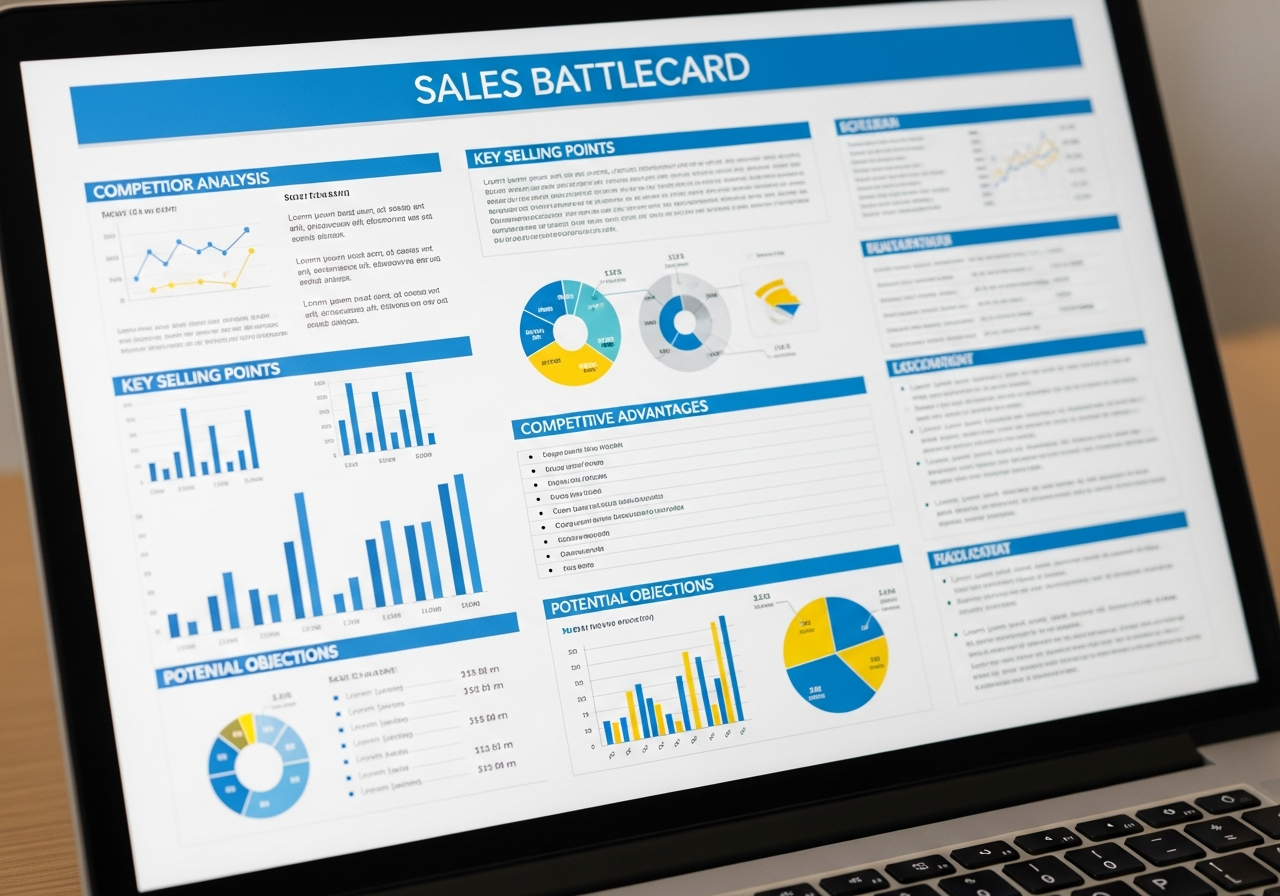 Making a good sales battlecard template is about more than just putting down facts. The design should share vital information in a way that is easy to use. It should help your sales strategy. People from both the sales and marketing team often work together on this. That way, the content is clear and right.
The best design puts focus on clarity and makes things easy to find. It shines a light on key features and shows what makes you better than others. The aim is to help your sales reps get what they need fast. Now, we will see the main parts to add and how to set them up for the best use.
Core Components to Include in Your Template
When you create battle card templates, it is important to add the right parts for sales enablement. The template should give sales teams the key information they need. This helps them show what makes you better than others. Start with a simple overview of your product or service. Highlight what is special about it and why people should pick it.
The template should also have a section for looking at the competitor analysis. Show their strengths, the things they do not do well, and where they stand in the market. There should also be an area for ways to handle common objections. Share tested points for your sales teams to use when these come up.
Some essential pieces that should be there are:
-
Your Unique Selling Propositions (USPs): Show what makes your offer stand out from the rest.
-
Competitor Profile: Give key facts about others, like their products and how much they charge.
-
Objection Handling: Set up answers for sales teams to use when customers have questions.
-
Customer Success Stories: Share real cases that show the value of your product.
Organizing Key Information for Fast Access
How you put key information together is just as important as the details you share. Your battlecard should be a quick reference guide for the sales staff. It should help people find the information they need fast when they are on a sales call. Do not use thick paragraphs or messy layouts. These make everything hard to scan.
Use clear headings, bullet points, and bold text to break up the content. This will help your team find specific talking points or data. It means they do not lose focus during the sales process. Keep the card short, but you can use links for those who want detailed information.
Try to add visual aids, like charts or easy infographics, to compare things like features and pricing. These tools help turn tough details into something people can get right away. With the right setup, your sales staff can grab what they need and use it to win calls.
Step-by-Step Guide to Creating Your First Sales Battlecard
Making your first sales battlecard template may look hard at first, but having a step-by-step guide makes things much easier. These are vital pieces of marketing collateral that help sales professionals do well. Both sales managers and marketing teams work together to make sure the sales battlecard is helpful. The process begins with research and ends with a tool that your team can use in real sales work.
You can create the battlecard in a sales enablement platform or even in a simple document. No matter how you start, your goal is the same. You want to build a resource your sales team wants to use. For the best results, follow these steps so your battlecard is of real value.
Researching Competitors and Market Positioning
Thorough competitor research is the foundation of a powerful battlecard. Your sales strategy depends on understanding the competitive landscape and your market positioning. Start by identifying your primary competitors—the ones your sales team encounters most frequently.
Gather competitive intelligence by analyzing their products, pricing, marketing messages, and customer reviews. This key information will help you pinpoint their strengths and weaknesses. It's crucial to be honest in your assessment to prepare your reps for real-world conversations.
Organize your findings to create a clear comparison. A simple table can effectively summarize how your offering stacks up against a rival.
|
Feature/Aspect |
Your Company |
Competitor A |
|---|---|---|
|
Key Product Feature |
Feature X enables seamless integration. |
Lacks native integration support. |
|
Pricing Model |
Flexible subscription tiers. |
Rigid, high-cost annual contracts. |
|
Target Market |
Mid-to-Enterprise level businesses. |
Primarily small businesses. |
|
Known Weakness |
Newer brand in the market. |
Poor customer support ratings. |
Customizing a Sales Battlecard Template for Your Company
A basic template will help you get going, but a custom battlecard template made for your company will work much better. Personalizing the battlecard makes sure the sales tool shows your unique selling points. This also helps with the pain points your sales teams run into at work.
Start by talking with your sales reps to learn what they need. Ask them what questions come up most with customers. See which competitors give trouble the most to your sales teams. Take their answers and use them to decide what to put in your battlecard template. The main goal is to build a sales tool that gives real value right away when your teams go out to sell.
To make your template fit your needs:
-
Focus on your unique selling points and match these to customer pain points.
-
Align the content to fit your own target audience and buyer personas.
-
Add your company’s look and message so it feels the same as your other branding.
Real-World Sales Battlecard Examples and Use Cases
Theory is helpful, but real examples show how the idea works. When you look at use cases and case studies, you can see how sales teams use battlecards to win sales. These stories help people in sales know how to set up information for different competitive situations and industries.
You can have the battlecards on a sales enablement platform or as a simple file. The main thing is to use a good format so the information can be put to work right away. Now, let's look at some applicable use cases and relevant case studies. We will cover a SaaS example and a B2B competitive case to show what good battlecards look like in the real world.
SaaS Sales Battlecard Example
For SaaS companies, product battle cards help you find your way in a busy market. These cards talk a lot about things like feature comparisons, how well tools work together, and pricing models. All of these matter a lot in the sales process for SaaS. A good product battle card helps your team explain technical points in a way that is easy for anyone to understand.
Think about a battlecard that compares your project management software with a top rival. It will show off your better collaboration features, an interface that is easier to use, and good customer support. This card will also give your sales team ideas for what to say on sales calls. These talk tracks help your team show customers that your product is the right way to get better team work.
This kind of card is helpful when people ask about your product roadmap or want more details on how something works. It lets your team answer questions with ease and helps set your product apart from others.
B2B Competitive Deal Example
In a big B2B deal where competition is tough, a battlecard is something every sales rep should have. The goal of this use case is to help show why your value proposition is better when someone is comparing you to another company. The card should be made to guide the rep so they can talk more about your competitive advantages.
For example, if you have a battlecard for a B2B deal, it could have "landmine" questions for you to ask. These questions can help you spot where your rival is weak. It should also give real proof like case studies or customer testimonials. You can use these during your sales pitch to make your point stronger.
In the sales process, reps use this card while they get ready for meetings and think about what their competitor might do. It gives them what they need to fight off claims from the other team, push the value proposition you offer, and lead the prospect to pick your solution.
Best Practices for Using Sales Battlecard Templates in the US Market
Making a sales battlecard template is not just about making a new document. For this tool to work well, sales managers need to bring it into the sales process. By using best practices in sales enablement, sales teams and sales representatives can really get the most from this sales tool.
Rolling out the battlecard the right way—and keeping it updated—matters a lot. Everyone on the team should think of the battlecard as a must-have, not just more paperwork. Below are some best practices that will help when training your team and spotting common mistakes in design.
Training Reps and Rolling Out Battlecards
Effective sales enablement starts when you train sales professionals to use battlecards. Do not just send the file through email and hope your sales team members start using it. Have training sessions where you walk sales staff through the layout and details of the battlecard.
You can use role-playing to show sales professionals how the battlecard can help during calls. This helps them learn how to bring it in when talking to people. If customer success teams join these sessions, they can share what customer pain points and problems they see. This helps everyone on the team know what to do if there are objections.
For a good rollout:
-
Explain the "why" so the sales staff know what the battlecard does and how it helps each one win.
-
Hold practice sessions to help them get more sure and clear about using it.
-
Gather feedback from the sales team members after you start to make things better.
Common Mistakes to Avoid in Sales Battlecard Design
When you make battle card templates, you need to be careful not to make some common mistakes. One of the main things that goes wrong is adding too much info. When there is too much on the card, it is hard to look at and hard to use. This means sales reps may not find what they need fast. You want battle cards to help with sales enablement, not make the job harder.
Another big mistake is putting in outdated or incorrect information. If a rep shares the wrong numbers or gets something about a competitor wrong, people may not trust them again. This could also hurt the deal. The content has to be right and checked all the time.
To make battle cards that work, do not fall for these common problems:
-
Overloading with text: Keep every card short and easy to read, not full of too much information.
-
Failing to update: Using old information is even worse than having nothing.
-
Ignoring customer pain points: Make sure your content is about the customer and the real pain points they have.
-
Using a one-size-fits-all approach: Each card should match the competitor or the situation, not be for everyone.
If you keep these in mind, your battle card templates will be a good tool for sales enablement.
Maximizing Impact: Updating and Evolving Your Sales Battlecard
A sales battlecard template should not be something you use once and forget about. To get the most out of it, you need to update the content often. The market can change. Other companies can do things in new ways. Customers will have new questions. Keeping your sales battlecard up to date means your sales teams always have the most critical information.
If you do not update your cards, your team might use old information. This could be about a competitor’s market value or annual run rate. Setting up a process for keeping your battlecard template current is key if you want it to work well for a long time.
Keeping Content Fresh and Relevant
Keeping your content new and useful is the most important thing in sales enablement over time. If a sales professional finds that the key information is old, they might stop trusting the tool. Have your marketing team check and update all battlecards often.
Look at competitor websites, social media, and news updates to catch any changes. Your sales professionals can also give fresh information. Ask them to give their insights from the field using your sales enablement platform or at regular meetings.
To keep content up to date:
-
Schedule quarterly reviews of all battlecard content.
-
Create a feedback loop for sales reps to report new competitor activity.
-
Verify all data and talking points to make sure they are correct.
Measuring Effectiveness and Iterating Design
How do you know if your battlecards are working? It is important for sales managers to measure how well this sales tool is doing. You should look at how often the cards are used and see if that lines up with win rates against each competitor. These numbers help you see if the battlecards are making a real difference.
It's also good to get other feedback. Ask your sales team if the battlecards help them answer customer questions or show the value proposition to customers in a better way. You can find out if there is anything in the design or words that needs to be changed.
To measure and improve:
-
Track usage data in your sales enablement platform.
-
Survey your sales team about how easy the cards are to use and how helpful they are.
-
Analyze win/loss data to check if using battlecards is helping you get more wins.
Summary
To sum up, learning how to use the sales battlecard template can make your sales team work better and faster. When you put all the essential information in one place, with quick access to competitive insights, a good battlecard helps sales representatives handle tough deals with more confidence. It's important to keep your battlecard templates updated, so they work well in a market that keeps changing. This is true for companies in SaaS and B2B. Following best practices can help people get better results and do a good job. If you want to improve your sales strategy, you can download our sample sales battlecard templates and start your journey today.
Frequently Asked Questions
How can I download or access sample sales battlecard templates?
You can find many sample battle card templates on the websites of sales enablement tools and marketing resource hubs. These free resources are good for sales teams, sales professionals, and customer success teams who want to make their own battle card.
What makes a sales battlecard template work best for SaaS companies?
For SaaS companies, good product battle cards help sales reps talk about key features in a way that is simple to follow. These cards also show how different integrations work and break down pricing tiers. They help sales reps focus on the unique selling points that make their product stand out in a busy market. The cards also help to answer what competitors say about technology or performance.
How should sales reps use battlecards during competitive deals?
When there is a tough deal, sales reps should use battlecards before they go into sales calls. This helps them get ready and know what the other side might do. They can look at the card to find specific talking points, ask smart questions to the prospects, and use competitive intelligence to push back on what the other company says.
Sources:
https://www.instagram.com/harte.hanks/
https://www.youtube.com/channel/UCzvoAoVXV9PDK8j3NdPURnw
https://www.thealliance.io/revenue-alliance
https://www.hubspot.com/products/sales/document-tracking