

Nike Org Chart Report
Nike Org Chart & Deep Dive Sales Intelligence Report: Nike Key Insights & Overview
NIKE, Inc.
One Bowerman Drive
Beaverton, OR 97005-6453
United States
Main Phone: (503) 671-6453
Website: https://www.nike.com
Sector(s): Consumer Cyclical
Industry: Footwear & Accessories
Full Time Employees: 83,700
Annual Revenues: $51.54 Billion USD
Fiscal Year End: May 31
Fortune 500 Rank: #93
CEO: Elliott Hill
What's in the Databahn NIKE Org Chart and Deep Dive Sales Intelligence Report?
The Databahn deep dive NIKE Org Chart and Sales Intelligence Report is designed to eliminate costly research time and uncover new sales opportunities. The Databahn Report has comprehensive Org Charts, accurate Contact Info, Seller Insights (value propositions, prospecting questions, cold emails that will resonate with <COMPANY> executives), Business and Financial Insights, Industry Insights, Executive Profiles, Technology Insights, and dozens of Sales Trigger Events. Basically, everything you need to build a strategic account plan.

What were the significant executive changes at Nike in 2025?
Key NIKE executive changes in 2025 centered on a major C‑suite and senior leadership reorganization under CEO Elliott Hill’s “Win Now” plan.
Created a new EVP, Chief Operating Officer role and appointed Venkatesh (Venky) Alagirisamy, formerly Chief Supply Chain Officer, as EVP & COO, effective December 8, 2025.
Expanded COO remit to include Technology in addition to Supply Chain, Planning, Operations, Manufacturing, and Sustainability, with an explicit mandate to integrate technology end‑to‑end across create‑plan‑make‑deliver‑sell.
Eliminated the EVP, Chief Technology Officer role from the Senior Leadership Team; CTO Muge Dogan exited the company as a result.
Eliminated the EVP, Chief Commercial Officer role; CCO Craig Williams left the company.
Elevated the four geography leaders to the NIKE, Inc. Senior Leadership Team, now reporting directly to Elliott Hill:
Angela Dong – Greater China
Carl Grebert – Europe, Middle East and Africa (EMEA)
Tom Peddie – North America
Cathy Sparks – Asia Pacific Latin America (APLA)
Moved Global Sales and Nike Direct to report into EVP & CFO Matt Friend, consolidating marketplace, direct‑to‑consumer, and strategy under finance leadership to tighten alignment between market execution and corporate strategy.
Collectively, NIKE describes these 2025 changes as removing management layers, better connecting operations and technology, and accelerating execution of its Win Now turnaround strategy.
What is the Nike Mission Statement and Business Philosophy?
Nike's mission statement is:
"To bring inspiration and innovation to every athlete in the world." (The asterisk clarifies with Bill Bowerman's quote: "If you have a body, you are an athlete."")
This statement emphasizes three key aspects:
- Inspiration: Nike aims to motivate people to pursue their athletic goals and embrace the power of movement.
- Innovation: The company is committed to developing cutting-edge products and technologies that enhance athletic performance.
- Inclusivity: Nike defines "athlete" broadly to encompass everyone with a body, regardless of skill level.
Beyond the mission statement, Nike's business philosophy is guided by several core principles:
- Focus on the Athlete: Everything Nike does centers around understanding and meeting the needs of athletes at all levels.
- Innovation: Continuous development of new technologies and designs is a core tenet of Nike's approach.
- Sustainability: The company strives to minimize its environmental impact and operate responsibly.
- Community: Nike is committed to giving back to the communities where it operates and supporting social causes.
These principles are often referred to as Nike's "11 Maxims" and serve as a guiding light for employee decision-making. Essentially, Nike aims to be a company that inspires and empowers people to achieve their athletic potential through innovation, while remaining a responsible and sustainable global citizen.
Who is the current CEO of Nike in 2026?
Elliott Hill is the current President and CEO of Nike in 2026. He became CEO effective October 14, 2024, returning to the company after an earlier retirement in 2020.
Hill’s growth strategy is framed as the “Win Now” plan, a sports‑focused turnaround launched in 2025 to address slowing growth and competitive pressure. He emphasizes “leading with sport” and putting the athlete at the center of every decision, with five main priorities: culture, product, marketing, marketplace, and in‑person retail presence. The plan realigns roughly 8,000 employees around core sport categories, doubles down on innovation in running, basketball, football, training, and sportswear, and seeks to strengthen wholesale partnerships while sharpening pricing and inventory discipline.
Hill’s background is almost entirely Nike‑grown. He first joined Nike as an intern in 1988 and over more than 32 years held 14–19 different roles across sales, marketing, and general management in North America and Europe. Before retiring in 2020, he served as President, Consumer and Marketplace, overseeing all global commercial and marketing operations for Nike and the Jordan Brand and helping grow Nike to over 39 billion dollars in revenue. He holds a bachelor’s degree in Kinesiology from Texas Christian University and a master’s in Sports Administration from Ohio University, and has served on TCU’s board of trustees.
Who is on the Nike Executive Leadership team in 2026?
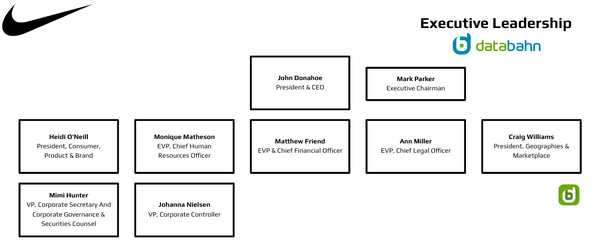
| EXECUTIVE NAME | JOB TITLE | MAIN PHONE NUMBER | MOST COMMON NIKE EMAIL PATTERN |
| Philip H. Knight | Chairman Emeritus | +1 503 671 6453 | first.last@nike.com |
| Mark Parker | Executive Chairman | +1 503 671 6453 | first.last@nike.com |
| Elliott Hill | President & CEO | +1 503 671 6453 | first.last@nike.com |
| Venkatesh Alagirisamy | EVP, Chief Operating Officer | +1 503 671 6453 | first.last@nike.com |
| Aaron Cain | President & CEO, Converse, Inc. | +1 503 671 6453 | first.last@nike.com |
| Dr. Thomas Clarke | Chief Growth Initiatives Officer | +1 503 671 6453 | first.last@nike.com |
| Angela Dong | Chairman & CEO, Greater China | +1 503 671 6453 | first.last@nike.com |
| Matthew Friend | EVP, Chief Financial Officer | +1 503 671 6453 | first.last@nike.com |
| Michael Gonda | EVP, Chief Communications Officer | +1 503 671 6453 | first.last@nike.com |
| Nicole Graham | EVP, Chief Marketing Officer | +1 503 671 6453 | first.last@nike.com |
| Carl Grebert | Vice President & General Manager, Europe, the Middle East and Africa (EMEA) | +1 503 671 6453 | first.last@nike.com |
| Treasure Heinle | EVP, Chief People Officer | +1 503 671 6453 | first.last@nike.com |
| Rob Leinwand | EVP, Chief Legal Officer | +1 503 671 6453 | first.last@nike.com |
| Phil McCartney | EVP, Chief Innovation, Design & Product Officer | +1 503 671 6453 | first.last@nike.com |
| Sarah Mensah | President, Jordan Brand | +1 503 671 6453 | first.last@nike.com |
| Ann Miller | EVP, Global Sports Marketing | +1 503 671 6453 | first.last@nike.com |
| Amy Montagne | President, Nike | +1 503 671 6453 | first.last@nike.com |
| Tom Peddie | Vice President & General Manager, North America | +1 503 671 6453 | first.last@nike.com |
| Cathy Sparks | Vice President & General Manager, Asia Pacific Latin America (APLA) | +1 503 671 6453 | first.last@nike.com |
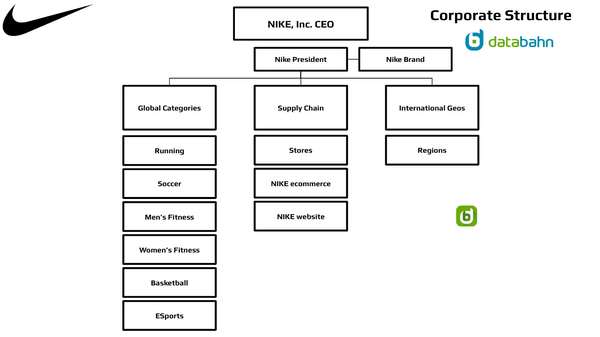
Nike Org Chart - Corporate Structure
What are Nike’s growth strategies for 2026 and beyond?
Nike’s growth strategy for 2026 and beyond is an extension of Elliott Hill’s “Win Now” turnaround, evolving into a longer‑term sport‑offense and channel‑rebalancing play.
Core strategic pillars
Lead with sport and performance: Refocus on core performance categories (running, basketball, football, training) and sport‑led sportswear, pulling back from over‑indexed lifestyle franchises.
Sport Offense realignment: From FY26, Nike is aligning teams into a “Sport Offense” structure designed to accelerate Win Now actions and reposition the business for future growth.
Innovation engine and demand creation: Unify product creation across Nike, Jordan, and Converse and significantly increase demand‑creation spend, with demand creation expected to exceed 5 billion dollars in fiscal 2026.
Marketplace and channel strategy
Re‑balancing DTC and wholesale: Reverse the prior over‑rotation to DTC by rebuilding key wholesale relationships and reclaiming shelf space with strategic partners while keeping Nike Digital as a premium, less promotional channel.
Inventory and margin discipline: Aggressive inventory normalization through mid‑2026, fewer off‑cycle promotions, and tighter assortment management to relieve gross‑margin pressure and restore premium positioning.
Geographic focus: Treat a small number of “three core countries” and priority markets (including China) as critical growth engines, even as execution there remains challenging.
Operational and financial ambitions
Operational streamlining: Leadership and org changes (e.g., new COO role, fewer management layers) are aimed at faster decision‑making and closer integration of supply chain, tech, and product.
Digital and AI leverage: Expand use of digital, data, and AI across product creation, merchandising, and supply chain to improve speed‑to‑market and reduce cost‑to‑serve.
Medium‑term targets: Analysts and management commentary frame the goal as stabilizing in FY26, then returning to sustainable growth with expanding margins as Sport Offense, inventory cleanup, and channel mix improvements take hold.
Who are Nike’s top competitors in the marketplace?
Nike faces competition from several major players in the athletic apparel and footwear market. Here are some of their top competitors:
- Adidas: The German multinational is Nike's biggest competitor, with a strong global presence and a similar range of products across footwear, apparel, and accessories.
- Puma: A smaller but growing competitor, Puma offers a more affordable alternative to Nike and Adidas, and has gained traction in recent years with innovative technologies and celebrity endorsements.
- Under Armour: An American brand focusing on performance apparel and footwear, particularly popular in the United States.
- VF Corporation: This parent company owns several athletic and outdoor apparel brands like The North Face, Vans, and Timberland, competing with Nike in specific segments.
- Lululemon Athletica: While primarily known for yoga apparel, Lululemon has expanded into general athleticwear and competes with Nike for the women's fitness market.
Beyond these major players, Nike also faces competition from:
- New Balance: A brand known for its focus on comfort and offering a wider range of shoe widths.
- Skechers: An American company offering a more casual and lifestyle-oriented athletic footwear option.
- Asian Brands: Li Ning and Anta are Chinese athleticwear brands gaining popularity domestically and pose a growing threat in the Asian market.
The specific competitive landscape can vary depending on the product category and geographic location. However, Nike's main battlegrounds are with established giants like Adidas and Puma, while also keeping an eye on emerging brands and niche players.
Who was elected to Nike’s Board of Directors in 2026?
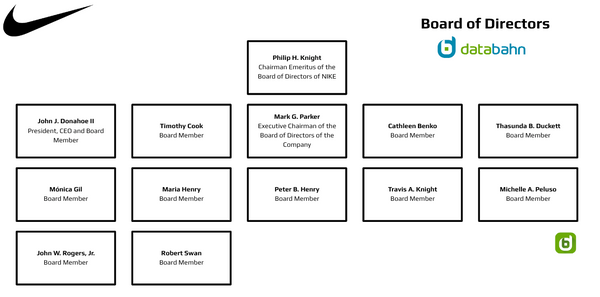
| EXECUTIVE NAME | JOB TITLE AND AFFILIATIONS | MAIN PHONE NUMBER | MOST COMMON NIKE EMAIL PATTERN |
| Mark G. Parker | Executive Chairman of the Board, NIKE, Inc.; former President & CEO of NIKE, Inc. | +1 503 671 6453 | first.last@nike.com |
| Elliott J. Hill | President & Chief Executive Officer, NIKE, Inc.; Director | +1 503 671 6453 | first.last@nike.com |
| John W. Rogers Jr. | Independent Director, NIKE, Inc.; Chairman & Co CEO, Ariel Investments | +1 503 671 6453 | first.last@nike.com |
| Peter B. Henry | Independent Director, NIKE, Inc.; Dean Emeritus, NYU Stern School of Business | +1 503 671 6453 | first.last@nike.com |
| Robert (Bob) Swan | Independent Director, NIKE, Inc.; former CEO, Intel; Audit & Finance Committee chair roles | +1 503 671 6453 | first.last@nike.com |
| Maria Henry | Independent Director, NIKE, Inc.; former EVP & CFO, Kimberly Clark | +1 503 671 6453 | first.last@nike.com |
| Tim Cook | Independent Director, NIKE, Inc.; CEO, Apple Inc. | +1 503 671 6453 | first.last@nike.com |
| Thasunda Duckett | Independent Director, NIKE, Inc.; President & CEO, TIAA | +1 503 671 6453 | first.last@nike.com |
| Cathleen Benko | Independent Director, NIKE, Inc.; Vice Chair Emeritus, Deloitte | +1 503 671 6453 | first.last@nike.com |
| Travis Knight | Independent Director, NIKE, Inc.; President & CEO, LAIKA, LLC | +1 503 671 6453 | first.last@nike.com |
| Michelle Peluso | Independent Director, NIKE, Inc.; former EVP & Chief Customer Officer, CVS Health | +1 503 671 6453 | first.last@nike.com |
| Monica Gil | Independent Director, NIKE, Inc.; EVP & Chief Administrative & Marketing Officer, NBCUniversal Telemundo | +1 503 671 6453 | first.last@nike.com |
| Philip H. Knight* | Chairman Emeritus, NIKE, Inc.; co founder and former CEO | +1 503 671 6453 | first.last@nike.com |
What Technology Platforms have been deployed across Nike?
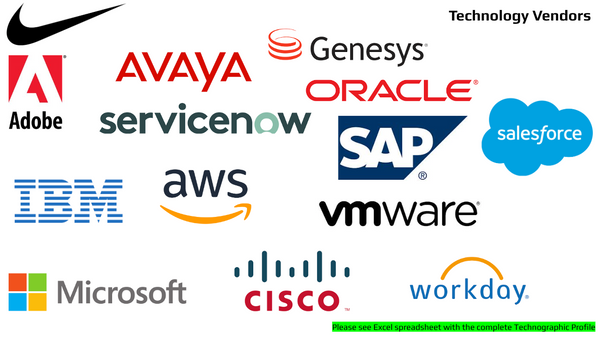
Here are some of the technology platforms Nike has likely deployed across its operations:
E-commerce and Direct-to-Consumer (DTC) Channel:
- E-commerce platform: Nike has its own robust e-commerce platform for online sales, offering features like product browsing, shopping carts, secure payment gateways, and order tracking.
- Customer Relationship Management (CRM) system: This helps manage customer data, personalize marketing campaigns, and track customer interactions across touchpoints.
- Warehouse Management System (WMS): Optimizes inventory management within Nike's distribution centers, ensuring efficient order fulfillment for online and physical stores.
Mobile App:
- A mobile app exists to enhance the customer experience. It includes features like:
- Product browsing and purchasing capabilities.
- Personalized product recommendations based on past purchases or browsing behavior.
- Membership and loyalty program management.
- Content feeds with workout tips, athlete stories, or exclusive product launches.
Supply Chain Management:
- Enterprise Resource Planning (ERP) system: This integrates various business functions like finance, inventory, and production, providing a holistic view of Nike's operations.
- Supply Chain Management (SCM) software: Tracks the movement of materials and finished goods throughout the supply chain, optimizing logistics and ensuring on-time deliveries.
Product Design and Development:
- Computer-aided design (CAD) software: This allows for 3D modeling and design of footwear and apparel, facilitating the design process and prototyping.
- Product Lifecycle Management (PLM) system: Manages the entire lifecycle of a product, from design and development to manufacturing and end-of-life.
Data Analytics and Marketing:
- Business intelligence (BI) tools: Used to analyze customer data, sales trends, and market performance to gain insights and inform decision-making.
- Marketing automation platforms: Automate marketing tasks like email campaigns, social media marketing, and targeted advertising based on customer data.
Other Platforms:
- Cloud computing platforms: Nike leverages cloud services from providers like Amazon Web Services (AWS) and Microsoft Azure for scalability, data storage, and running some of their applications.
- Artificial intelligence (AI): AI is used in various areas like product recommendations, personalized marketing, or chatbot customer service.
It's important to note that this is not an exhaustive list, and the specific technology platforms Nike utilizes can be referenced in the Nike Technographic Profile.
Databahn Customer Testimonials

Complete the form below to request a sneak peek at the Nike Org Chart and Company Profile Report