Selling Into Bank of America: A Field Guide for Cutting Through the Noise
If you're selling enterprise technology or AI into Bank of America and watching emails stall with no clear path to power and painfully slow deals, you're not alone. Bank of America is massive, matrixed, and risk-driven. It rewards well-orchestrated plays, not one-off outreach or generic "we help banks modernize with AI" pitches.
The real problem usually isn't your product. It's the lack of an org map: no clear view of who matters, what they care about, and how your solution fits into Bank of America's own priorities across AI, digital, risk, and core technology.
This field guide is for Strategic and Enterprise AEs and Sales Directors who own Bank of America as a greenfield or underpenetrated account. Five practical ways to get started: grounding your narrative in BoA's strategy, mapping decision-makers and influencers, tailoring who to call and what to say, aligning to real programs and initiatives, and respecting the vendor expectations and risk lens that govern every serious decision inside the bank.
1. Start with Bank of America's strategy, not your product
One of the fastest ways to stall a Bank of America conversation is to lead with a product-centric pitch. This is a bank that manages trillions in assets and operates under a Responsible Growth philosophy. You need to start from how Bank of America thinks about growth, risk, and technology, not from your feature set.

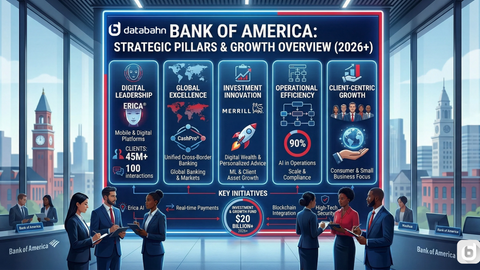
Before contacting anyone, spend time understanding how Bank of America publicly talks about Responsible Growth and operating within its risk appetite, operational excellence and strong controls, digital client experience across consumer, wealth, and corporate clients, and AI-enabled productivity and smarter decision-making.
Then ask: where does our solution clearly intersect with this story? If you can't articulate that connection in one or two tight, BoA-specific sentences, no senior stakeholder has a reason to engage.
A stronger starting point for any AE sounds less like "we're an AI platform that modernizes banks," and more like "we help large banks like Bank of America make AI and automation safer and more scalable, by improving X outcome while staying within their risk and control framework."
The goal isn't to echo press releases. It's to speak Bank of America's language well enough that your outreach feels relevant to its agenda from the first sentence.
2. Map the buying center before you send the first email
At Bank of America, "who to call" is never just one person. It's a buying center: executives who own strategy and budget, directors and senior managers who run programs and platforms, risk, compliance, and control stakeholders who can veto, and procurement and vendor management teams who govern the relationship.
Treat Bank of America like a mid-market logo, firing off emails to one senior title and waiting, and you'll almost guarantee slow, opaque outcomes. Treat it like a complex buying center and your whole motion changes.

Before you send a single piece of outreach, you should have at least a working view of: the line of business or function you're targeting (technology infrastructure, digital channels, information security, data/AI, operations, payments, or treasury), the key executives in that area and how their responsibilities are described, the directors and senior managers likely responsible for programs or platforms your solution would touch, and the risk, compliance, and vendor management stakeholders who will care about controls, data, and resilience.
You don't need a perfect org chart on day one. You need a map good enough to support deliberate multi-threading. See a handful of connected stakeholders instead of one lonely name, and you stop guessing and start building a real plan: who to approach first, who to connect next, where the veto power likely sits.
3. Lead with context: who to call, what to say, what to ask
Inside Bank of America, a name and email are table stakes. What actually moves the needle is contact information with context: who this person is in BoA's internal story, what they've owned, and how their remit connects to the bank's AI, digital, risk, or modernization priorities.
Effective prospecting into BoA comes down to three questions: who exactly am I calling in the context of Bank of America's internal structure, what value proposition and strategic message is most likely to resonate with their world, and what informed questions can I ask that earn a thoughtful response instead of a quick delete?
Two simplified examples: a leader in digital channels or AI-powered client interactions will respond to messaging about engagement, personalization, latency, and trust. A leader in infrastructure, operations, or information security will respond more to resilience, performance under load, operational efficiency, and risk reduction.
Send both the same "we help banks modernize with AI" email and you've wasted everyone's time.
Instead, write messages that acknowledge the environment they live in (balancing innovation with risk and control, modernizing while maintaining uptime, scaling AI responsibly), connect your solution to specific outcomes they care about (fewer manual steps, faster cycle times, improved fraud detection, more secure digital interactions, better developer productivity), and use informed, open-ended questions that show you've done your homework. Questions like that signal respect for BoA's complexity and invite real dialogue instead of a perfunctory "not a priority right now."
4. Tie your solution to real programs and initiatives, especially AI and digital
Bank of America doesn't buy "tools" in isolation. It funds programs and initiatives. Want to avoid slow, ambiguous "interesting, but not now" replies? Your solution needs to live inside real, named efforts, not off to the side.
Across the bank, technology decisions are often tied to multi-year programs around AI and analytics for smarter, faster decisions; digital client experiences across consumer, small business, commercial, and corporate segments; risk and control modernization; payments, treasury, and transactional platforms; and infrastructure, data, and application modernization.
Your account research should answer questions like: which initiatives, platforms, or transformation programs could our solution realistically support or de-risk? Where does our technology extend or complement what Bank of America already uses, rather than simply competing with existing investments? How does our solution help the bank advance its stated goals in client experience, efficiency, or risk reduction?
Say "we see three specific ways this can support your AI and digital initiatives in [area]," and you're giving stakeholders something they can connect to their internal roadmap. That's very different from asking them to invent a business case from scratch.
A serious account plan for Bank of America surfaces these initiatives, connects them to executives and program leads, and shows how your technology can help those programs succeed. That's the level of alignment that gets you invited into real conversations.
5. Respect the risk lens, vendor expectations, and the long game
Even if you do everything above correctly, deals at Bank of America will still slow or stall if you underestimate the role of risk, compliance, and vendor management. In a bank this size and this regulatorily visible, internal risk and control stakeholders can quietly kill or delay your deal unless you've anticipated their questions and concerns.
Selling into Bank of America means recognizing that every serious technology decision is viewed through a risk and control lens, not just a feature and price lens; that vendor management and supplier expectations aren't a back-office formality but central to how the bank evaluates and governs third-party technology; and that the more critical or data-adjacent your solution is, the more scrutiny you should expect around resilience, security, compliance, and continuity.
The vendors that succeed here build that reality into their selling motion from the beginning. They come prepared to explain how they handle security, data privacy, testing, incidents, and resilience in clear, non-defensive terms. They anticipate the documentation and internal approvals the opportunity will require, and set expectations accordingly. They frame their technology not just as a way to generate value, but as a solution that can withstand BoA's risk and compliance scrutiny over the long term.
Treat Bank of America as a long-term program, not a one-off logo, and your behavior changes. You stop chasing quick wins and start building the relationships, proof points, and internal comfort that lead to multi-year, multi-line-of-business expansion.
Putting it all together: a practical way to get started
If Bank of America is a greenfield or underpenetrated account for your AI or enterprise tech solution, the answer isn't "send more emails" or "push harder for a meeting." The answer is a sharper, BoA-specific motion: start from Bank of America's strategy and language, not your generic product deck; recognize there's a buying center, business, technology, risk, and vendor management, and map it deliberately; give your team clear guidance on who to call, what to say, and what to ask, based on the context of each stakeholder; connect your solution to real programs and initiatives, especially around AI, digital, risk, and modernization; and respect the bank's risk lens and vendor expectations, planning for the long game.
Do that and a few things change quickly. You eliminate a huge amount of research time that would otherwise fall on individual reps. You uncover new sales opportunities by seeing where your technology naturally fits into Bank of America's roadmap. And you accelerate sales cycles by engaging the right people, in the right order, with the right narrative.
That's precisely what a deep-dive account intelligence approach for Bank of America is designed to enable: org maps, contact information, executive bios, technology stack insights, strategic initiatives, competitive angles, recommended messaging, and informed prospecting questions, all pulled into one place so your team can stop guessing and start selling.
Next Steps
If you want a Bank of America field brief, org map, and messaging guide tailored to your solution and your go-to-market, that's the work I do every day, and I'm happy to explore what that could look like for your team. Complete the Contact Form below and a friendly member of our team will reach out to you.
Sources:
https://www.databahn.com/pages/bank-of-america-2026-account-strategy-sales-intelligence-report