

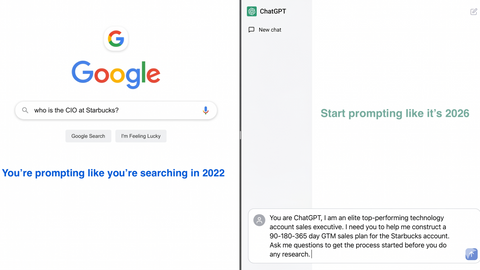
A practical prompting playbook for enterprise AEs targeting greenfield Fortune 1000 accounts.
If you're an enterprise AE carrying a seven-figure number into greenfield or whitespace Fortune 1000 accounts, you don't have time for AI parlor tricks. You need it to do three things, fast: help you build a real account plan, sharpen your sales strategy, and turn that strategy into concrete, tactical plays.
I've spent 25 years in sales intelligence and strategic account research. These days I use AI every day as a force multiplier for that work, not by typing "write an email" and hoping for the best, but by using a handful of specific prompting styles that actually drive better thinking. This is a walk-through of the core ones I rely on: Zero-Shot, Few-Shot, Chain-of-Thought, and ReAct, plus a few supporting styles you'll reach for constantly and a bonus called pull prompting. (I put a longer version of this into a Databahn Prompt Engineering Guide for Enterprise Sales Execs if you want the reference doc.)
Every example below is written for you: a senior enterprise AE targeting a greenfield Fortune 1000 account.

Zero-Shot: point AI at the problem
Zero-Shot is the simplest style. You describe the task in plain language and let the model figure out how to respond, no examples, no setup. For complex selling, it's your fastest way to get oriented on an account, a theme, or an idea before you go deeper.
What it is: a clear instruction and desired output, no examples attached.
How it helps a greenfield AE: it gets you off the blank page fast, when you're still at "I don't even know where to start" on a new account.
Account overview prompt: "You are a strategic sales analyst supporting an enterprise AE. Give me a concise 10-bullet overview of [Company]: business model, key segments, main products, go-to-market motion, and any major strategic initiatives mentioned in recent earnings calls or press releases."
Problem space prompt: "From a senior enterprise AE's perspective, list 7 plausible business problems [Company] is likely trying to solve in the area of [your solution category]. For each one, include why it matters, who's likely accountable (title-level only), and how success would be measured."
Zero-Shot won't hand you a finished account plan, but it'll get you out of staring at the logo hoping for inspiration.
Few-Shot: teach AI your best moves
This is where AI starts to feel like a teammate. Instead of just describing the task, you show it a few examples of what good looks like, your best emails, your best call plans, your best executive summaries, and ask it to produce more in that style.
What it is: 2 to 10 input-output examples, then a request for a similar output on a new input.
How it helps a greenfield AE: it's built for scaling your own best work across new logos, cold emails that convert, executive summaries that land with VPs, talk tracks for a first meeting in a new vertical.
Outbound email prompt (greenfield CIO): "Here are 3 cold emails I've sent to CIOs at large enterprises that led to meetings: [Email 1], [Email 2], [Email 3]. Analyze the structure, tone, and value proposition. Now write 2 new first-touch emails to the CIO at [Target Company], in the same style and structure, tying the message to their likely priorities based on their latest 10-K and earnings call."
First-meeting agenda prompt: "Here are 2 first-meeting agendas I've used with VPs of Operations at Fortune 1000 accounts where deals progressed to late stages: [Agenda A], [Agenda B]. Extract the common patterns. Then design a 45-minute discovery agenda for a first meeting with the VP of Operations at [Target Company], including time boxes and 6-8 questions that will surface both strategic initiatives and immediate pains."
With Few-Shot, you're not asking AI to be creative. You're asking it to clone your best patterns for a new logo.
Chain-of-Thought: make the model think like a strategist
If Few-Shot is about style, Chain-of-Thought is about thinking. You explicitly tell the model to reason step by step before answering, exactly what you want when you're building a greenfield plan with no existing deal context, no active opportunity, no internal history to lean on.
What it is: telling the model "think this through step by step" and structuring the prompt so it has to show the reasoning, not just the answer.
How it helps a greenfield AE: it's ideal for parsing strategy documents and 10-Ks, turning company strategy into concrete sales opportunities, and designing multi-threading or land-and-expand plans.
10-K into sales plays prompt: "You are a strategic account planner with 25+ years of Fortune 1000 experience. Think step by step. Read this excerpt from [Company]'s latest 10-K and earnings call: [paste text]. First, list their top 5 strategic priorities in your own words. For each priority, infer 1-2 operational challenges or execution risks. Then map each challenge to a specific sales play we could run with our [solution category]. Show your reasoning at each step before giving the final list of plays."
Multi-threading prompt: "Think step by step about how [Company] would evaluate and deploy a solution like ours. First, list the major phases of a typical enterprise buying process for this type of solution. Second, for each phase, identify the 3-5 most likely stakeholders involved and what they care about. Third, propose a multi-threading strategy: which titles we should engage, in what order, with what message, and at what stage. Show your reasoning at each stage before giving the final plan."
The value of Chain-of-Thought isn't just the answer, it's that you can inspect the reasoning and decide where to push back or refine.
ReAct: reason and act in a loop
ReAct, short for Reason plus Act, is how you get AI to behave more like a research assistant hopping between tools than a static text generator. In ReAct-style prompts, you have the model alternate between thinking, taking an action (searching the web, checking a knowledge base, querying a CRM), observing the result, and thinking again based on what it found. It's basically what you already do when you open a new logo: bouncing between LinkedIn, earnings calls, press releases, org charts, and your own notes, updating your read of the account with each click.
What it is: a loop of Thought, Action, Observation, Thought, repeated until you reach a goal.
How it helps a greenfield AE: it drives its own research sequence, decides what to look up next, and stops once it has enough to propose plays, emails, or a plan. Even without formal tools wired up, you can mimic the pattern with instructions like "search for X, summarize it, then decide what to search next."
Guided research prompt: "You are my AI research analyst. Follow this loop:
- Thought: based on what we know so far, what's the most important next question to answer about [Target Company] for a greenfield sales motion?
- Action: search the public web for information that answers that question.
- Observation: summarize briefly what you found. Repeat this Thought, Action, Observation loop 3-4 times, until you can confidently propose three strategic initiatives we should align to, five likely executive stakeholders (titles only), and three specific beachhead opportunities we could lead with. At the end, present your final recommendations in a structured brief."
You're essentially asking AI to run a mini discovery process on the open web before you send a single email.
Supporting styles you'll use constantly
A few smaller patterns underpin almost everything above.
Role or persona prompts. Tell the model who to be: "Act as a CFO at a Fortune 1000 manufacturing company evaluating a new [your solution] vendor. Given this email, what would you like and what would you ignore?" Or: "Act as a skeptical VP of Sales reviewing this account plan. What's missing or unrealistic?" This one trick noticeably sharpens the relevance of the feedback you get back.
Context or priming prompts. Front-load who you are, what you sell, and who you target before asking for anything: "I'm a senior enterprise AE selling [solution] into Fortune 1000 [industry]. ACV is [X]. Sales cycle is [Y]. Our best customers buy us to solve [problems]. Based on this context, review [Target Company]'s strategy and tell me if they look like a Tier 1, 2, or 3 target and why." Give AI the same background you'd give a new SE shadowing your territory.
Prompt chaining. Instead of asking for a full account plan in one shot, break it into steps: summarize the company's strategy and initiatives, turn that summary into plausible business problems, turn those problems into concrete sales plays, then turn those plays into a 90-day account penetration plan. It mirrors how you already think; AI just speeds it up.
Bonus: pull prompting, turning AI into a thinking partner
Most AEs default to push prompting: stuffing every detail into one giant prompt and hoping the model spits out something usable. Pull prompting flips that. Instead of writing the perfect prompt up front, you state your goal, let the AI ask you focused questions to figure out what it needs, and iterate together until the output is sharp. Think of it like coaching a junior rep: they don't need a three-page brief, they need a clear goal and permission to ask questions.
What it is: an interaction where the model drives the clarification by asking you questions, instead of you over-engineering the first prompt.
How it helps a greenfield AE: it's useful whenever you're not sure how to ask for what you want, you're still working through the strategy yourself, or you want AI to help structure your own thinking.
Example interaction:
You: "Help me build a 1-page strategic account plan for [Target Fortune 1000 Company]. I sell [solution] into [ICP]. This is a pure greenfield logo."
AI, prompted correctly: "Happy to help, but I need a few details first. What's your typical champion or buying center? What key outcomes do your best customers care about? What's your average land deal size and time-to-value?"
You answer, it drafts something, then asks: "Do you want to emphasize a land-and-expand motion or a bigger initial land? Any strong competitor presence we should assume?"
By the end you've got a co-built account plan that reflects both your read of the territory and the model's research. You can even make this explicit in your instructions: "You are my AI account planning partner. My goal is to build a solid greenfield account plan for [Company]. Ask me 5-10 targeted questions about my product, ICP, sales motion, and constraints before drafting. Ask follow-ups if anything's unclear before finalizing." That's the difference between AI as a content vending machine and AI as an actual partner in how you think about your territory.
Bringing it together
Here's roughly how I'd weave all of this into a repeatable workflow for a greenfield Fortune 1000 account: start with Zero-Shot to get oriented, a quick company overview and a first pass at plausible problem areas. Move to Chain-of-Thought to turn strategy into plays, working step by step from the 10-K and earnings call through initiatives, risks, and sales plays. Layer in ReAct-style prompts to drive focused research, letting the model decide what to look up next and when it has enough to recommend stakeholders and plays. Use Few-Shot to scale your best messaging, feeding it your winning emails and agendas so it can generate new ones for the account. Frame the whole thing with role, context, and chaining, positioning the model as a strategic sales analyst with your ICP in mind, then chaining prompts from strategy to plays to tactics. And whenever you're stuck, fall back on pull prompting: let the AI ask you the questions you'd ask a junior rep, and build from there.
That's the actual shift: from "AI writes my email" to AI helping you think through and operationalize a complex, seven-figure greenfield motion.
If this gave you a clearer way to think about AI prompting as a senior enterprise AE, especially into greenfield or whitespace Fortune 1000 accounts, I'd love to stay connected. Connect with me on LinkedIn if you want more concrete prompt templates for account planning, executive research, and multi-threading.
AI won't replace top-performing enterprise reps. The reps who learn to drive it with the right prompts will outpace the ones who don't.
Sources: