
Most "AI for sales" conversations land in the same place: more templated emails, more generic insights, more decks nobody reads.
That's not what enterprise sales leaders actually want. They want new revenue they didn't know existed, exec and board connections they can actually use, and messaging that gets replies because it's timely, relevant, and personal. The way most teams use AI right now won't get them any of that. They treat it like a smarter Google search: almost no inputs, shallow questions, shallow answers.
1) Overfeed the AI with the right documents
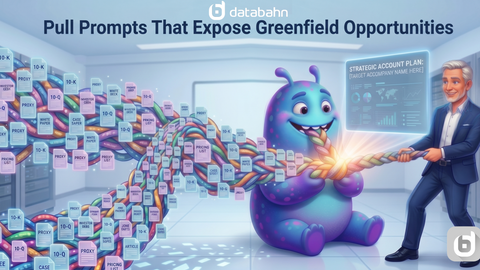
Forget "a couple of links." Think full account diet: 10-Ks, 10-Qs, proxy statements, investor decks, earnings call transcripts, sustainability and ESG reports, job descriptions, leadership profiles, whitepapers, spec sheets, solution briefs, customer stories, case studies, competitive pages, partner listings, plus dozens of good URLs: industry deep dives, analyst notes, blogs, consortiums, association sites, strategy and M&A press releases.
Not every AI platform is equally strong at live web crawling, so I usually download and package the best material into a few files, then give the AI one workspace to sit with the account.
2) Use pull-prompts, not just "better prompts"
Most prompts push AI to produce an answer out of thin air. Pull-prompts flip that: you tell the AI the outcome you want, give it context, and make it interview you for what it's missing before it responds. Here are two your enterprise AEs can reuse.
Pull-prompt for account plays: "You are my sales intelligence strategist for a greenfield Fortune 1000 account. I'll give you company documents, URLs, and our solution overview. Goal: propose 3 concrete account plays (who to target, why now, what motion). Step 1: read everything I've given you. Step 2: before suggesting any plays, ask me up to 15 focused questions to fill gaps, about our product, ICP, pricing, current customers, landmines, internal constraints, channel, and so on. Step 3: once I've answered, summarize what you learned in 10 bullet points. Step 4: propose 3 named plays with target roles/contacts, business problem, hypothesis, talk track, and next best action."
That's the AI pulling discovery out of you instead of guessing at a strategy.
Pull-prompt for high-response outreach: "You are my outbound strategist for this account. I'll share company docs, a few exec and board LinkedIn URLs, and 2-3 relevant case studies. Goal: craft one email that's relevant, timely, and personal to a specific executive. First, ask me up to 10 questions: the exact persona, current deal context, our proof points, risk areas, tone, and anything you can't find in the documents. Don't write the email until I answer. Then pull 3-5 current initiatives from the documents that this person likely owns or cares about, choose one, and write a short email that uses their own language from earnings calls or interviews, ties it to one specific outcome we've delivered for a similar customer, and ends with a clear, low-friction next step."
Same idea: the AI has to ask before it writes anything specific or believable.
3) What happens when you actually do this
I've been running this with clients for a few weeks now, and combining aggressive inputs with disciplined pull-style prompting has surfaced real, net-new opportunities in accounts that used to look like just another logo. A couple of recent cases turned into multi-million-dollar opportunities in ECM and cybersecurity, not luck, just the result of overfeeding AI properly and forcing it to act like a sales intelligence analyst instead of a trivia engine.
If your current AI story is "we write emails faster," you're leaving most of the value on the table. The real question is what changes when your AI stops being a content generator and starts being your sharpest sales intelligence partner on greenfield, high-value strategic accounts.
Would a simple one-pager of these pull-prompts be useful to hand your enterprise AEs? Connect with me on LinkedIn and send a note: "pull prompts".
Sources: